
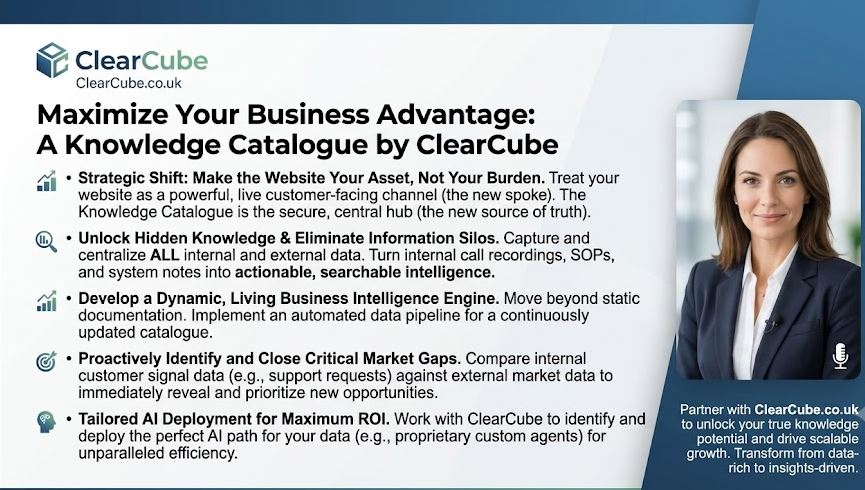
A knowledge catalogue is essential for any modern organization because it serves as the central, organized index for all an enterprise's data and information assets. It enables humans and AI to find, understand, and trust their data quickly, breaking down operational silos.
Think of it as the operating system for your institutional memory—a single source of truth that turns raw data scattered across a company into actionable knowledge.
Here is a detailed breakdown of why a knowledge catalogue is important, categorized by its main benefits.
1. For Human Productivity: Stopping the Search
In companies without a formalized knowledge catalogue, employees spend a significant percentage of their time just looking for information.
-
Accelerates Data Discovery: Instead of emailing colleagues or navigating obscure folder structures, users can perform a natural language search (e.g., “show me last quarter's customer churn data”) to locate the relevant assets instantly.
-
Saves Time and Money: By centralizing information, organizations can save employees hours per week on average, reclaiming time that can be spent on meaningful, analytical work.
-
Improves Onboarding: New hires can become productive faster because they have immediate access to a complete repository of documented processes, glossaries, and project histories.
2. For AI Implementation: Grounding & Accuracy
The primary barrier to successful generative AI (like agents built on Large Language Models) in enterprises is "hallucination"—when the AI invents incorrect facts because it lacks specific context.
-
Eliminates Guesswork: An AI agent needs precise retrieval of semantic context in milliseconds. The knowledge catalogue acts as the "context layer," feeding the exact right documentation or database schema metadata into the agent’s prompt.
-
Provides Pre-validated Logic: Instead of an AI guessing how to join different databases, the catalogue provides verified SQL patterns (“golden queries”) and central business glossaries to ensure the AI's output is deterministic and accurate.
3. For Data Governance and Compliance: Safety at Scale
As organizations accumulate massive amounts of distributed data (dark data), they need automated ways to manage, protect, and observe it.
-
Enforces Strict Access Control: You cannot allow an AI agent (or unauthorized employee) to read sensitive financial or HR records. A knowledge catalogue enforces global, policy-based access permissions based on who is querying it.
-
Automates Data Governance: Modern catalogues automatically scan data to identify sensitive information (like PII), track where data comes from (data lineage), and monitor its accuracy (data quality).
-
Unlocks “Dark Data”: Enterprises have massive amounts of unstructured data (PDFs, images, emails) stored in cloud buckets. AI-powered knowledge catalogues can parse these files, extract the entities inside, and make them searchable.
4. For Business Strategy: Better Decision-Making
A knowledge catalogue transforms raw bits into highly organized Data Products that have business meaning.
-
Creates a Business Glossary: It bridges the gap between technical teams and business teams by linking technical metadata (column names) to business context (standardized definitions of metrics), reducing ambiguity.
-
Proactive Impact Analysis: Because the catalogue tracks data lineage, developers or engineers can see exactly which AI features, reports, or analytical models rely on a specific database column before they change it, preventing downstream systems from breaking.
Summary: The Operational View
| Without a Knowledge Catalogue | With a Knowledge Catalogue |
| Data is scattered across silos. | Data is centralized and discoverable. |
| Time wasted looking for the "right" dataset. | Rapid access to a curated inventory. |
| Reliance on "tribal knowledge" from long-time employees. | Institutional knowledge is documented and accessible to all. |
| AI agents hallucinate due to lack of corporate context. | AI agents are grounded in accurate, verified business context. |
| Changes to data break downstream reports. | Data lineage allows for proactive impact analysis. |